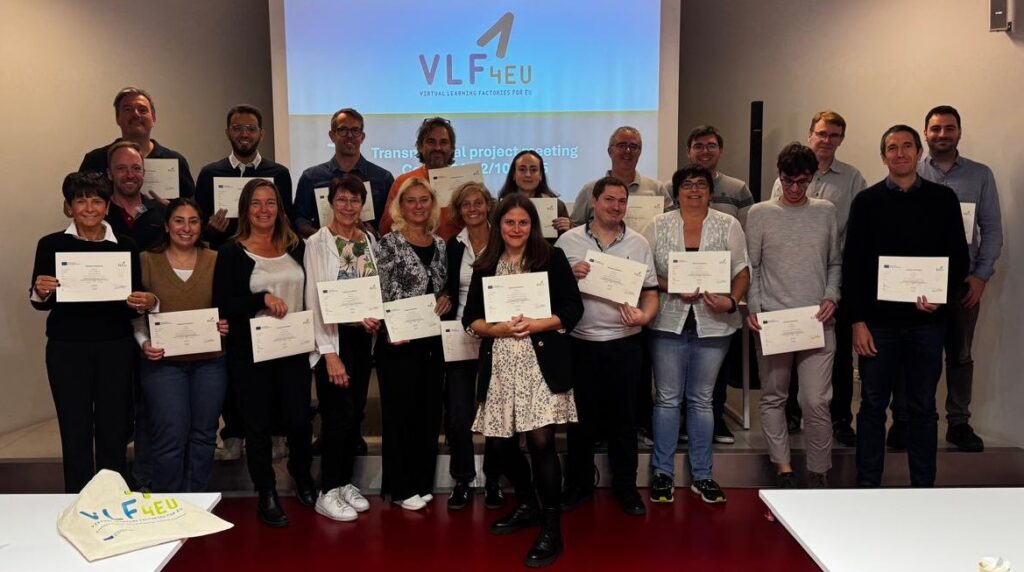
On October 1–2, 2025, ECOLE and UCIMU welcomed the VLF4EU consortium at ComoNExT Innovation Hub (Lomazzo, Milan area) for the 9M (Month 9) Transnational Project Meeting. The two-day event brought together project partners from across Europe to consolidate progress, align on next steps, and strengthen collaboration around the shared vision of building Virtual Learning Factories for the future of education and industry.
The meeting opened with institutional greetings and a guided visit to the Fabbrica Diffusa and the Coelux start-up, offering a hands-on experience of robotics labs and artificial daylight technologies. Participants also met several innovative companies based at ComoNExT, including AI4, QBT, and XPLO, highlighting the strong link between advanced manufacturing, artificial intelligence, and entrepreneurial ecosystems.
Key technical discussions and updates
The first working session focused on WP2 – the creation of the VLF4EU Alliance, led by AFM and IMH. The team presented a comprehensive update on the legal and strategic framework of the Alliance, including membership categories, governance bodies, and draft statutes. A follow-up workshop explored collaboration models among members.
In the afternoon, UCN led WP3, showcasing the methodology and tools developed to implement Virtual Learning Factories across Europe. The team presented the ongoing work on the VLF Toolkit, design principles, and pedagogical scenarios. Notably, partner interviews and explanatory videos have helped shape the learner-centered approach of the project.
Following this, CESI, IMH, ECOLE, GTC, UCN, and others contributed to a rich discussion under WP4, centered on platform development. INNOVAE introduced ERAVIS, the immersive and modular VLF4EU platform, and presented its functional structure and use cases. Though time constraints delayed the planned workshop, it was rescheduled for Day 2 to allow deeper engagement on pedagogical integration.
Pedagogical scenario co-design and Industry 5.0 learning modules
The second day resumed with collaborative sessions where MecaBotiX, SCSKZ, IMH, and GTC shared their own pedagogical scenarios and industrial use cases. From teleoperated robots and UR10/CNC machine integrations to advanced AGV systems and scenario-based automation training, each contribution enriched the shared pool of ideas and use cases.
A practical workshop followed, focusing on scenario design around three core technologies: AGVs, robot arms, and CNC machines. Each group defined learning objectives, hardware/software requirements, and skill levels (EQF-aligned), contributing to the project’s inclusive and scalable learning vision.
Before closing the meeting, IMH presented the roadmap for WP5, centred on Industry 5.0-oriented learning modules and the introduction of micro-credentials. The session invited feedback from partners and opened the floor for future co-creation workshops.
Looking ahead
The Milan meeting concluded with a wrap-up session on WP7 and WP6. UCIMU recalled the upcoming dissemination deadlines (notably D7.2 in January 2026), while ELESAR outlined next steps for the VLF4EU Open Innovation Model. The consortium also confirmed key future actions, including preparations for BIENAL 2026 and the 1st VLF4EU Conference, as well as the next transnational meeting to be held in Sweden (GTC) in February 2026.