The transformation of European industry is moving forward at great speed. Digitalisation, automation, artificial intelligence, robotisation, the intensive use of data and the green transition are changing the way industrial products are designed, produced, maintained and marketed. However, this transformation is not only technological. Its success will depend, to a large extent, on the ability of companies, training systems and institutions to prepare the people who will have to lead it and apply it in their day-to-day work.
This is one of the main conclusions of the report “D2.4 – Report on competencies and skills gaps – First Version”, prepared within the framework of the European project “VLF4EU – Virtual Learning Factory Networking and Strategy Build Up: Supporting EUropean Industrial Digitalisation Competitiveness and Growth for All”. The study analyses current and emerging needs for industrial skills in six European countries (Denmark, France, Italy, Slovenia, Spain and Sweden) and offers a comparative view of how Industry 4.0 and Industry 5.0 are transforming professional profiles, jobs and training systems.
The report starts from a reality shared across Europe: the existence of a growing gap between the skills demanded by industrial companies and the capabilities available in the labour market. This gap does not only affect highly specialised profiles, such as data engineers, artificial intelligence experts or automation managers. It also has a direct impact on technicians, operators, maintenance staff, technical sales profiles and shopfloor workers, whose roles are evolving towards increasingly digital, connected and sustainable environments.
From traditional jobs to hybrid profiles
One of the most significant changes identified in the report is the transition from jobs based on specific tasks towards more hybrid and skills-based professional profiles. In the new industrial context, mastering a technique or a machine is no longer enough. Professionals must understand systems, interpret data, collaborate with other departments, interact with digital tools and apply criteria related to efficiency, quality and sustainability.
As a result, profiles traditionally associated with production or maintenance are incorporating new responsibilities linked to data analysis, real-time monitoring, predictive diagnostics, basic programming, automation and interaction with artificial intelligence systems. Likewise, engineering and management profiles increasingly need to integrate knowledge related to sustainability, the circular economy, energy efficiency, cybersecurity, digital twins, collaborative robotics and immersive technologies.
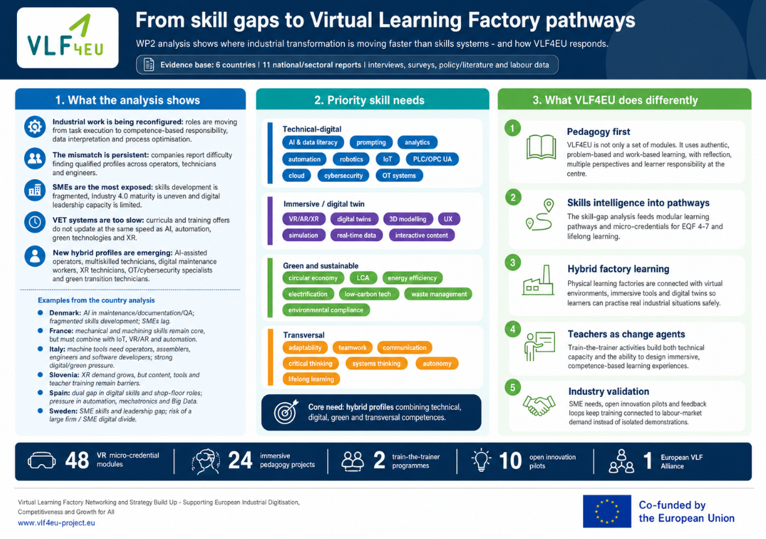
The result is a growing demand for hybrid skills that combine three major dimensions: technical-industrial knowledge, digital skills and environmental awareness. These are complemented by transversal skills such as adaptability, communication, teamwork, critical thinking, continuous learning and problem-solving.
This combination is fully aligned with the Industry 5.0 approach, which places people at the centre of industrial transformation. In contrast to a purely technological vision, Industry 5.0 proposes a more human, sustainable and resilient industry, where technology serves competitiveness, but also the well-being of workers and the sustainability of the production system.
A common gap across Europe
Although each country analysed has its own specific characteristics, the report identifies common trends. Denmark and Sweden show a high level of digital maturity and a strong focus on the green transition, but also face difficulties in extending training to SMEs and lower-skilled workers. France and Italy, with a solid industrial tradition, face structural mismatches between the training available and the real needs of companies. Slovenia stands out for its commitment to XR technologies (virtual, augmented and extended reality), although it still needs to overcome barriers related to infrastructure and digital literacy. Spain, for its part, reflects a dual need: to make progress in digitalisation while also strengthening essential technical profiles in production, maintenance, machining and product development.
Digitalisation, sustainability and human skills
The technologies most frequently mentioned throughout the report clearly show where European industry is heading. Big Data, cybersecurity, collaborative robotics, cloud computing, cyber-physical systems, machine vision, virtual and augmented reality, additive manufacturing, artificial intelligence and predictive maintenance appear as increasingly relevant areas. However, the report also underlines that technological adoption will not be sufficient unless it is accompanied by an appropriate skills development strategy.
The green transition adds another layer of complexity. Companies need professionals capable of applying criteria related to energy efficiency, waste reduction, life-cycle analysis, the circular economy, electrification, hydrogen, batteries and environmental management. These skills no longer belong only to specialised departments; they are beginning to form part of the regular responsibilities of many industrial profiles.
Alongside technical and digital skills, the report highlights the growing importance of so-called soft skills. In more interconnected, automated and multidisciplinary industrial environments, companies are looking for people who are able to collaborate, communicate, lead, adapt to change and learn continuously. The soft skills most highly valued by the companies include teamwork, leadership, communication and negotiation, proactivity, resilience, flexibility and critical thinking.
The challenge for training systems
One of the most relevant conclusions of the report is that education and vocational training systems are not evolving at the same pace as industry. In many countries, curricula are rigid, updating processes are slow and the connection between training centres and companies remains insufficient. This means that, even when training is available, it does not always respond to the real needs of the labour market.
The report points to the need to move towards more flexible, modular training models focused on specific skills. Training must allow active workers to update their knowledge quickly in specific areas, without always depending on long pathways or full qualifications. In this regard, short-duration formats, micro-credentials, blended learning, simulation environments, learning factories and on-the-job training are becoming central.
The report also underlines the importance of strengthening collaboration between companies, vocational training centres, universities, clusters, public administrations and innovation stakeholders. The transformation of skills cannot be addressed in isolation. It requires ecosystems capable of anticipating needs, designing agile training responses and facilitating access to upskilling and reskilling, especially for SMEs and workers with lower qualification levels.
People at the centre of industrial competitiveness
The main lesson of the report is clear: European industrial competitiveness will depend as much on technology as on people. Artificial intelligence, automation and sustainability will only generate real impact if companies have professionals who are prepared to use, interpret, adapt and improve them.
Industry 5.0 precisely introduces this change in perspective. It is not only about producing more or faster, but about building a smarter, more sustainable, resilient and human-centred industry. To achieve this, Europe needs to reduce the skills gap, modernise its training systems and promote a culture of lifelong learning.
The challenge is considerable, but so is the opportunity. If companies, training centres and institutions are able to work in a coordinated way, the industrial transition can become a lever for generating quality employment, strengthening SME competitiveness, driving innovation and consolidating a European industry that is prepared for the future.
VLF4EU response
VLF4EU responds directly to the challenge highlighted in the report: European industry is transforming faster than current skills development systems can adapt. By connecting Virtual Learning Factories, realistic industrial scenarios, digital and XR-based learning environments, and future micro-credential pathways, the project offers a practical way to bring training closer to the real needs of Industry 5.0. Its value lies in enabling learners, workers and teachers to experience advanced manufacturing technologies — such as automation, robotics, data-driven systems, digital twins and immersive environments — in safe, flexible and pedagogically structured settings. In this way, VLF4EU supports the development of hybrid competence profiles that combine technical-industrial knowledge, digital skills, sustainability awareness and transversal skills such as collaboration, adaptability and problem-solving. The project therefore contributes to reducing the gap between industrial innovation and workforce readiness, while supporting more agile, modular and industry-connected training ecosystems across Europe.
This article was produced with the assistance of AI tools and edited under the project’s editorial responsibility, in accordance with Article 50 of Regulation (EU) 2024/1689 (AI Act).