How can vocational education keep pace with the twin digital and green transition? VLF4EU’s new Collaboration Framework sets out a practical roadmap for a European Alliance that puts immersive, industry-ready learning within reach of every training provider.
The VLF4EU project has officially finished Deliverable D2.2: Report on the Collaboration Framework, a strategic document that defines how the VLF4EU Alliance will establish, consolidate, and expand cooperation among VET institutions, industry stakeholders, research organisations, technology providers, and policymakers across Europe.
The framework has been developed in response to one of Europe’s major challenges: successfully managing the twin digital and green transitions while ensuring that education and training systems equip learners and workers with the skills required for the future of industry. In this context, the report recognises collaboration as a fundamental pillar for developing innovative learning environments, strengthening workforce adaptability, and promoting lifelong learning opportunities.
At the heart of the initiative lies the concept of the Virtual Learning Factory (VLF): immersive and interactive learning environments that replicate real industrial settings through technologies such as Virtual Reality (VR), Augmented Reality (AR), Extended Reality (XR), and digital twins. These technologies have enormous potential to transform education and training by making learning more practice-oriented and closely aligned with the needs of Industry 5.0.
However, access to advanced digital technologies often remains a challenge for many vocational education and training (VET) providers and organisations due to financial, technical, and organisational barriers. The VLF4EU Collaboration Framework addresses this challenge by promoting structured cooperation and resource sharing among a broad range of stakeholders.
Building a European Alliance Around Virtual Learning Factories
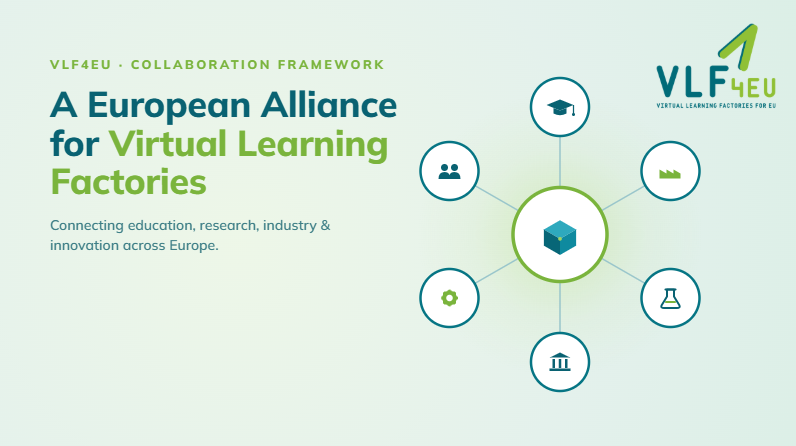
The report establishes the foundations of the VLF4EU Alliance as an inclusive and multidisciplinary ecosystem that brings together organisations from education, research, industry, and innovation. The Alliance is designed to support the adoption, development, and dissemination of Virtual Learning Factories and to ensure that innovative pedagogical approaches can be scaled up and sustained beyond the project’s lifetime.
The framework identifies several categories of organisations that can contribute to the Alliance, including:
- Education – Vocational education and training (VET) providers, universities, and schools interested in integrating Virtual Learning Factories into their educational activities.
- Research – Research institutions contributing scientific expertise and innovation capacity in areas such as digital twins, immersive technologies, and learning analytics.
- Industry – Industrial companies seeking upskilling and reskilling solutions for their workforce.
- Technology – Technology companies and innovation hubs that can provide access to cutting-edge digital solutions and experimentation environments.
- Policy & ecosystem – SMEs, clusters, public authorities, and policy organisations capable of amplifying the impact of Virtual Learning Factories at regional, national, and European levels.
By connecting these different actors, the Alliance aims to create a dynamic community of practice where knowledge, experiences, infrastructures, and use cases can be shared and further developed.
Addressing Key Challenges for Skills Development and Innovation
The Collaboration Framework also identifies strategic challenges that require collective action and coordinated efforts. Among these challenges are the need to bridge skills gaps through stronger cooperation between education and industry, support the upskilling and reskilling of experienced workers, attract younger generations to industrial careers, create new mobility opportunities for learners and teachers, and strengthen the resilience and competitiveness of Europe’s future workforce.
The report also emphasises the importance of ensuring that educational initiatives are aligned with regional and national development strategies and that Virtual Learning Factories become recognised tools for supporting digital transformation and sustainable industrial growth.
Ultimately, the Alliance seeks not only to promote innovative learning technologies but also to expand and continuously renew the European offer of Virtual Learning Factories through collaboration, shared resources, and mutual learning.
From Strategy to Action
To translate these objectives into practice, the Collaboration Framework proposes a broad range of collaborative activities. These include participation in industrial and educational forums, the organisation of workshops, webinars, seminars, and open days, direct engagement with companies and stakeholders, “Train the Trainers” programmes, gamified learning experiences, and the publication of scientific and professional contributions.
Creating Lasting Impact Across Europe
The Report on the Collaboration Framework represents an important milestone for the VLF4EU project. Beyond defining governance structures and collaboration mechanisms, the report provides a clear and practical roadmap for building a sustainable European ecosystem around Virtual Learning Factories.
By fostering cooperation between education, research, industry, and policymakers, the VLF4EU Alliance aims to accelerate the adoption of immersive learning technologies, support the development of future-oriented skills, and contribute to a more innovative and inclusive European industrial landscape.
The framework marks the beginning of a long-term journey towards a connected European community where Virtual Learning Factories become a powerful instrument for learning, innovation, and industrial transformation.
Interested in joining the VLF4EU Alliance? Get in touch to explore how your organisation can take part in building Europe’s next generation of Virtual Learning Factories.
This article was produced with the assistance of AI tools and edited under the project’s editorial responsibility, in accordance with Article 50 of Regulation (EU) 2024/1689 (AI Act).